How Much to Feed Your Dog: Complete Feeding Guide & Charts
DogMealGuide Editorial Team
DogMealGuide Editorial Team provides research-backed, practical advice to help dog owners make better nutrition decisions for their pets.
How Much to Feed Your Dog: Complete Feeding Guide & Charts
Portion size is one of the biggest levers you control over your dog's health. Feed too little and they lose muscle and energy; feed too much and the weight creeps on — often slowly, but with long-term consequences.
The honest answer is that there's no one-size-fits-all number. How much to feed your dog depends on their weight, age, activity level, metabolism, reproductive status, and the calorie density of the food you're using. This guide walks you through how to figure out a sensible starting portion and then tune it to your individual dog.
Key Takeaways
- Bag feeding guides are a starting point only — always adjust based on your dog's actual body condition.
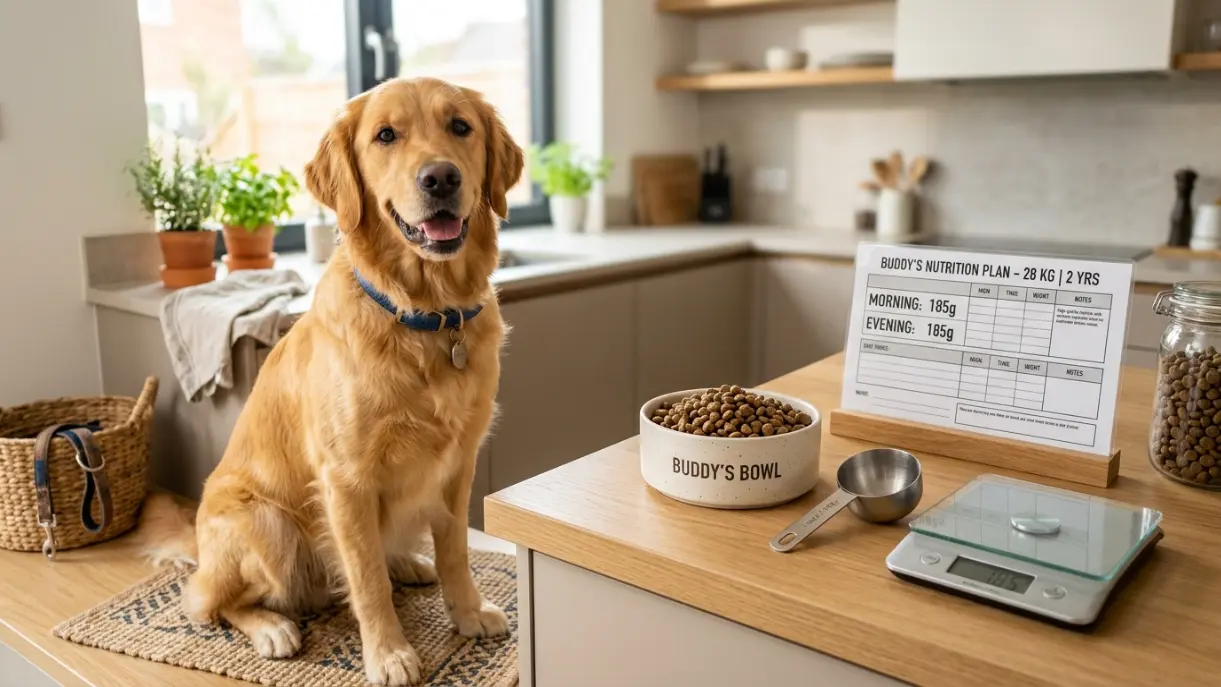
- Measuring by weight (grams) is more accurate than by volume (cups), since cup measurements vary between foods.
- Puppies, seniors, pregnant, and very active dogs have very different calorie needs from adult pets.
- Split daily portions into two meals for most adults; puppies generally need three to four.
- Recheck and adjust portions every 4–6 weeks based on your dog's body condition score.
Why Bag Feeding Guidelines Are Just a Starting Point
Every bag of dog food carries a feeding chart, and these charts are usually built around the average active, intact adult dog — which describes very few real pets. Spayed and neutered dogs typically need roughly 20–25% fewer calories. Sedentary dogs need less, seniors need less, and very active working dogs need more.
In practice, treat the bag chart as a rough floor to start from, not an exact prescription, and adjust based on what you actually observe in your dog. The numbers on the bag rarely match a specific pet perfectly.
Step 1: Know Your Dog's Ideal Weight
Start from ideal weight, not current weight. If your dog is already overweight, feeding for their actual current weight simply maintains the problem.
Ask your vet for a target weight, or estimate it using breed standards and body condition score (BCS). A BCS around 4–5 out of 9 is ideal: ribs you can feel with light pressure, a visible waist from above, and an abdominal tuck from the side.
Step 2: Find the Calorie Density of Your Food
Every dog food has a kcal/kg or kcal/cup value — usually printed on the bag or listed on the manufacturer's website. This is the single most useful number, because two foods that look similar can differ a lot in calorie density.
Example: One kibble might have 380 kcal/cup while another has 490 kcal/cup. Feeding the same cup amount of the denser food would mean about 30% more calories per day — enough to cause gradual weight gain over months.
Step 3: Calculate Your Dog's Daily Calorie Need
Use your dog's ideal weight to calculate their Resting Energy Requirement (RER):
RER (kcal/day) = 70 × (ideal body weight in kg)^0.75
This follows the standard method for estimating a dog's daily energy needs, which is then multiplied by a life stage factor:
| Dog Type | Multiply RER by |
|---|---|
| Neutered adult (low activity) | 1.6 |
| Intact adult (low activity) | 1.8 |
| Active adult | 2.0 |
| Working / sport dog | 2.0–5.0 |
| Puppy (under 4 months) | 3.0 |
| Puppy (4 months to adult size) | 2.0 |
| Senior / less active | 1.4 |
| Weight loss | 1.0 (or vet-guided) |
| Pregnant (last 3 weeks) | 3.0 |
| Lactating | 4.0–8.0 |
These factors are estimates, not exact prescriptions. A dog's true maintenance needs vary with body condition, activity, age, breed, health, and the specific food — so treat the result as a sensible starting point and adjust from what you observe.
Worked example — 25 lb (11.3 kg) neutered adult dog:
- RER = 70 × (11.3)^0.75 ≈ 70 × 6.17 = 432 kcal/day
- Neutered adult factor: 432 × 1.6 ≈ 690 kcal/day
- If food has 380 kcal/cup: 690 ÷ 380 ≈ 1.8 cups per day
Using this as a starting portion, then checking your dog's body condition over a few weeks, is more reliable than trusting the number blindly.
General Feeding Chart by Dog Size
Use this as a rough reference only. Cup amounts assume a typical kibble in the 350–380 kcal/cup range; if your food is denser or lighter, the cup amounts will shift, so always cross-check with your own bag's calorie density.
Small Dogs (under 20 lbs)
| Ideal Weight | Approximate Daily Food (typical 350–380 kcal/cup kibble) |
|---|---|
| 5 lbs (2.3 kg) | ¼ – ½ cup |
| 10 lbs (4.5 kg) | ½ – ¾ cup |
| 15 lbs (6.8 kg) | ¾ – 1 cup |
| 20 lbs (9 kg) | 1 – 1¼ cups |
Medium Dogs (20–50 lbs)
| Ideal Weight | Approximate Daily Food |
|---|---|
| 25 lbs (11.3 kg) | 1¼ – 1¾ cups |
| 35 lbs (15.9 kg) | 1¾ – 2¼ cups |
| 45 lbs (20.4 kg) | 2 – 2¾ cups |
| 50 lbs (22.7 kg) | 2¼ – 3 cups |
Large Dogs (50–100 lbs)
| Ideal Weight | Approximate Daily Food |
|---|---|
| 60 lbs (27.2 kg) | 2¾ – 3½ cups |
| 75 lbs (34 kg) | 3¼ – 4 cups |
| 90 lbs (40.8 kg) | 3¾ – 4¾ cups |
| 100 lbs (45.4 kg) | 4 – 5 cups |
Giant Dogs (over 100 lbs)
| Ideal Weight | Approximate Daily Food |
|---|---|
| 110 lbs (50 kg) | 4½ – 5½ cups |
| 130 lbs (59 kg) | 5 – 6½ cups |
| 150 lbs (68 kg) | 5¾ – 7 cups |
The ranges above are broad guides. Two dogs of the same weight can genuinely need different amounts depending on metabolism, body condition, and the food they eat, so let your dog's body condition be the final judge.
How Much to Feed a Puppy
Puppies need dramatically more calories per pound than adult dogs — they're building bone, muscle, brain tissue, and immune systems all at once. For a fuller look at puppy nutrition and feeding, see our high protein puppy food guide.
General Puppy Feeding Guidelines
- Under 4 months: Feed 3–4 times daily; needs can be up to 3× adult maintenance calories
- 4–6 months: Feed 3 times daily; gradually reduce toward 2× adult maintenance
- 6 months to adult size: Feed 2–3 times daily; transition toward adult portions
Portion by Puppy Age and Expected Adult Size
| Expected Adult Weight | 8 Weeks | 3 Months | 6 Months | 9 Months |
|---|---|---|---|---|
| Under 10 lbs | ¼ cup 3× | ¼ cup 3× | ¼ cup 2× | ¼ cup 2× |
| 10–25 lbs | ½ cup 3× | ½ cup 3× | ¾ cup 2× | ¾ cup 2× |
| 25–50 lbs | ¾ cup 3× | 1 cup 3× | 1½ cups 2× | 1¾ cups 2× |
| 50–100 lbs | 1 cup 3× | 1½ cups 3× | 2½ cups 2× | 3 cups 2× |
| Over 100 lbs | 1½ cups 3× | 2½ cups 3× | 3½ cups 2× | 4 cups 2× |
Always use puppy-specific food until your dog reaches adult size. Large and giant breeds should use large-breed puppy formulas, which are formulated with controlled calcium and phosphorus levels to support healthy bone development. If you have a big pup, start with our top puppy food for large breeds guide.
How Much to Feed a Senior Dog
Dogs are generally considered senior around 7 years (earlier for giant breeds, later for small breeds). Their metabolism tends to slow, activity often drops, and muscle mass can decline.
Key Adjustments for Senior Dogs
- Reduce calories if they're gaining weight — often around 20–30% below their active adult peak, unless bloodwork and body condition indicate otherwise
- Prioritize high-quality protein to help preserve muscle mass
- Consider smaller, more frequent meals — two moderate meals are easier to digest than one large one
- Senior formulas are typically lower in calories and fat, higher in fiber, and often include joint-supporting ingredients such as glucosamine
Some senior dogs actually lose weight and need more calories — this is not uncommon in dogs over 11–12 years. Monitor body condition monthly and adjust accordingly.
How Meal Frequency Affects Portions
Your dog's total daily calories stay the same however you split them, but frequency affects hunger, energy, and digestion.
| Life Stage | Recommended Meals Per Day |
|---|---|
| Puppy under 4 months | 3–4 |
| Puppy 4–6 months | 3 |
| Puppy 6 months+ | 2–3 |
| Adult dog | 2 |
| Senior dog | 2 |
| Large/giant breed (bloat risk) | 2–3 (no vigorous exercise before/after) |
Free feeding — leaving food out all day — only works for dogs who genuinely self-regulate, which most dogs do not. It makes portion tracking difficult and can contribute to obesity.
Adjusting for Treats
Treats are an easy source of hidden calories. If your dog gets treats during training, as rewards, or as chews, those calories should come out of the daily food allowance.
The 10% guideline: treats should generally make up no more than 10% of your dog's daily calories — a guideline echoed by veterinary guidance on treats and snacks.
- For a 600 kcal/day dog: roughly 60 kcal in treats
- A typical medium-sized commercial treat ≈ 40 kcal (check the label)
- A small piece of cooked chicken breast ≈ 10 kcal
When using high-value treats in training, reduce mealtime kibble proportionally — or use pieces of your dog's regular kibble ration as the treat itself.
Wet Food, Raw Food, and Mixed Feeding
Wet Food Portions
Wet food is usually 70–80% moisture, so you need more by volume than kibble for the same calories. A general rule of thumb: one 13 oz can is approximately equivalent in calories to ¾–1 cup of kibble for an average adult dog — but always check the specific food's kcal label, since products vary.
Mixing Wet and Dry
When mixing, reduce each proportionally. If you're replacing 25% of kibble calories with wet food, reduce the kibble by 25% and add the wet-food equivalent of 25% of the daily calories.
Raw Food Portions
Some owners feed raw, and a common rough starting convention is 2–3% of ideal body weight per day, split across two meals. This percentage is only a starting point — it does not, by itself, guarantee that a diet is nutritionally complete or balanced.
- 25 lb dog: roughly 0.5–0.75 lbs of food daily
- 50 lb dog: roughly 1–1.5 lbs daily
- 75 lb dog: roughly 1.5–2.25 lbs daily
Raw and homemade diets require careful formulation to avoid nutritional gaps, so it's wise to work with a veterinarian or veterinary nutritionist before committing to one long-term. If you're cooking at home, our homemade dog food recipes for beginners explain how portioning fits into balanced meals.
Signs You're Feeding Too Much or Too Little
Overfeeding signs
- Ribs hard to feel without firm pressure
- No visible waist from above
- Belly droops below the chest line
- Weight gain despite no change in routine
- Less energy and interest in play
Underfeeding signs
- Ribs visible without touching
- Spine and hip bones prominent
- Dog always acting hungry, food-obsessed
- Weight loss without intentional dieting
- Low energy or poor coat condition
The monthly check
Weigh your dog on a consistent schedule — once a month is a good habit. Track the numbers over time. A gradual upward or downward trend tells you far more than any single measurement.
Frequently Asked Questions
How much should I feed my dog a day in cups? It depends on your dog's weight, age, activity level, and the calorie density of the food. As a rough range for a typical adult neutered dog on a 370 kcal/cup kibble: small dogs (under 20 lbs) about ¼–1¼ cups; medium dogs (20–50 lbs) about 1¼–3 cups; large dogs (50–100 lbs) about 2¾–5 cups. Cross-reference with your food's label and your dog's body condition.
Should I feed my dog once or twice a day? Twice a day works well for most adult dogs. It keeps energy more stable, reduces hunger-driven behavior, and for large or deep-chested breeds is often preferred to lower the risk of bloat. Once-daily feeding is not necessarily harmful for small dogs, but is generally not ideal for large or deep-chested breeds.
How do I know if I'm feeding my dog enough? Use the rib test: place your hands on their ribcage and press lightly — you should feel each rib easily but not see them. There should be a visible waist from above and a belly tuck from the side. If ribs are hard to feel, reduce food; if they're clearly visible, increase food.
Can I feed my dog the same amount every day? For most adult dogs, yes — as long as their activity and weight stay stable. Adjust seasonally (less in winter if your dog is less active), after major life changes (spay/neuter, illness, changes in exercise), and as they age.
Why is my dog always hungry even on the right portion? Some dogs always seem hungry regardless of portion size. Highly palatable or carbohydrate-heavy foods can be digested quickly, so hunger can return sooner. Splitting the same total daily calories into three smaller meals can help, and a higher-protein, higher-fiber food may improve satiety. If hunger seems excessive or your dog is losing weight, it's worth a check-up with your vet.
Should I free-feed my dog? Only if your dog consistently leaves food in the bowl and keeps a healthy weight. Most dogs will overeat when given constant access to food, so measured meals give you far better control over intake.
The Bottom Line
Getting portions right isn't about following the bag to the letter — it's about understanding your individual dog and adjusting based on what you actually observe. Start with a calorie estimate, measure meals consistently, and reassess body condition monthly.
A dog at a healthy weight tends to be more energetic, is more comfortable, and is at lower risk of weight-related health problems. The small effort of measuring and adjusting pays off in the long run.
Topics
Our goal is to give you the most helpful, research-backed information possible. This content is for educational purposes only. For health concerns specific to your dog, always consult your veterinarian.
DogMealGuide Editorial Team
DogMealGuide Editorial Team provides research-backed, practical advice to help dog owners make better nutrition decisions for their pets.
This article is for educational purposes only and is not a substitute for professional veterinary advice.
Best Feeding Basics Guides
Our top expert-reviewed picks in this category